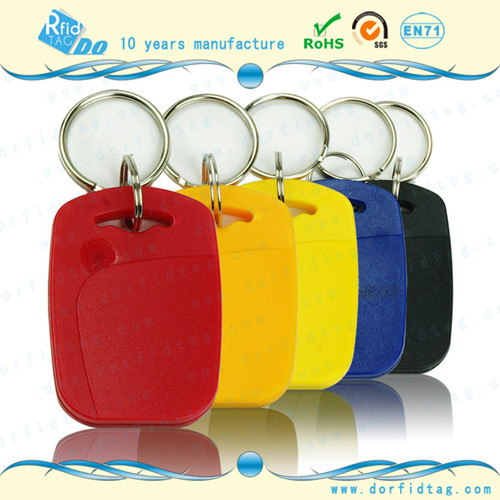
What Is an RFID Keyfob?

An RFID keyfob is a compact radio-frequency identification device designed for short-range contactless identification. It typically operates at LF (125 kHz) or HF (13.56 MHz) and follows standards such as ISO 14443 or ISO 15693, depending on the chip type.

Each RFID keyfob contains:

  • An RFID chip with a unique ID
  • A built-in antenna
  • A protective housing made from ABS, PVC, epoxy, or silicone

The keyfob form factor is intentional. It is easy to carry, attach to keys, resistant to daily wear, and difficult to damage compared to cards or stickers.


    RFID keyfob

    RFID keyfob is a small security hardware device with built-in authentication used to control and secure access to network services and data.It could be made of ABS and leather.

    Features

    • Water-proof
    • Duralbe with long life time
    • Easy for carry
    • Economy cost

    Request A Quote

    Description

    The tag are available with broad range of RFID technology, from low frequency 125KHz to high frequency 13.56MHz and UHF,thus it provides an optimal solution for different RFID applications. We accept the OEM manufacturing of RFID smart key fob.


    Primary Applications:

    • Access control
    • Attendance control
    • Identification
    • Tickets
    • Membership

    Specification

    Chip UHF: H3/H4,Monza 4/5,U Code 7;
    HF:N213,N 216,IC SLI,F08;
    LF:TK4100,EM4305.Or customized
    Protocol UHF:ISO18000-6C;
    HF:ISO14443A/ISO15693;
    LF:ISO18000-2
    Size More than 30 kinds keyfob for choose
    Memory 144,1K,128Byte,96bit,128bit,64bit,etc.
    Frequency 860-960MHz;13.56MHz;125KHz/134.2KHz
    Material ABS,Silicone,Plastic,PPS,PC,PA or customized
    Write Endurance ≥100000 cycles
    Read Range UHF:1-5m;HF/LF:0-5cm(depends on the reader and antenna)
    Aplication Access control,Identification,Payment management,or Customized,etc.
    printing Offset, Silk-screen
    Temperature -25~50 ‘C
    Weight 0.8kgs/100pcs


    The Core Problems RFID Keyfobs Solve

    1. Lost Keys and Unauthorized Duplication

    The pain point:
    Traditional metal keys can be easily lost, copied, or shared without authorization. Once lost, locks often need to be replaced entirely.

    How RFID keyfobs solve it:

    • Each keyfob has a unique, encrypted ID
    • Lost keyfobs can be instantly deactivated in the system
    • No need to change physical locks
    • Copying is far more difficult than duplicating metal keys

    This dramatically improves security while reducing replacement costs.


    2. Inefficient Access Management

    The pain point:
    Managing who has access to which door, area, or time window becomes chaotic with mechanical keys or basic cards.

    How RFID keyfobs solve it:

    • Access rights are digitally managed
    • Permissions can be assigned by user, location, and time
    • Access can be updated remotely in seconds
    • One keyfob can control multiple access points

    This is especially valuable for offices, residential complexes, hotels, and factories.


    3. Wear and Damage of Traditional Access Media

    The pain point:
    Cards crack, stickers peel, and paper-based credentials fail quickly in real-world use.

    How RFID keyfobs solve it:

    • Designed for daily physical handling
    • Water-resistant and impact-resistant
    • No printed surface required to function
    • Long service life, often 5–10 years or more

    RFID keyfobs are built to survive pockets, keychains, rain, dust, and routine abuse.


    4. Slow or Inconvenient User Experience

    The pain point:
    Swiping cards, inserting keys, or typing codes slows down access and frustrates users.

    How RFID keyfobs solve it:

    • Tap-and-go access
    • No line-of-sight required
    • Works instantly, even in low light or bad weather
    • Intuitive for all age groups

    Speed and simplicity reduce bottlenecks at entrances and improve user satisfaction.


    5. Lack of Traceability and Accountability

    The pain point:
    Traditional keys provide no record of who accessed what and when.

    How RFID keyfobs solve it:

    • Every access event can be logged
    • Supports audit trails and compliance
    • Helps identify misuse or security breaches
    • Integrates with attendance and monitoring systems

    This is critical for regulated environments such as healthcare, data centers, and manufacturing.


    How RFID Keyfobs Work in Practice

    1. The user brings the RFID keyfob close to a reader
    2. The reader emits a radio signal
    3. The keyfob responds with its unique ID
    4. The system checks permissions in the database
    5. Access is granted or denied instantly

    All of this happens in milliseconds, with no physical contact.


    Common Types of RFID Keyfobs

    LF RFID Keyfobs (125 kHz)

    • Long-established technology
    • Simple and cost-effective
    • Common in basic access control systems

    HF RFID / NFC Keyfobs (13.56 MHz)

    • Higher security options
    • Compatible with NFC systems
    • Used in modern access, payment, and smart building systems

    Different chips offer different memory sizes, encryption levels, and compatibility.


    Key Applications of RFID Keyfobs

    1. Access Control Systems

    Used in offices, apartments, schools, factories, and gated communities for secure entry management.

    2. Hotel and Hospitality

    Keyfobs serve as room keys, gym access credentials, and service area permissions.

    3. Residential Communities

    Residents use keyfobs for doors, elevators, parking gates, and shared facilities.

    4. Employee Identification

    Combines access control with attendance tracking and internal permissions.

    5. Parking and Vehicle Access

    Keyfobs enable fast, hands-free vehicle entry and exit management.


    Customization: Making RFID Keyfobs Fit Your Brand

    RFID keyfobs are highly customizable:

    • Shape and size (round, teardrop, square)
    • Color matching
    • Logo printing or laser engraving
    • Serial numbers or QR codes
    • Chip selection based on system needs

    This makes them suitable not only as security tools, but also as branded identity devices.


    RFID Keyfob vs RFID Card: Why Keyfobs Often Win

    Feature RFID Keyfob RFID Card
    Durability High Medium
    Portability Excellent Moderate
    Loss risk Lower Higher
    Daily handling Ideal Less ideal
    Lifespan Long Medium

    For long-term, daily-use scenarios, keyfobs often provide better value.


    Cost Efficiency and ROI

    Although RFID keyfobs cost more than basic cards or stickers, they deliver:

    • Lower replacement frequency
    • Reduced maintenance
    • Improved security
    • Lower administrative overhead

    Over time, they often cost less, not more.


    Why RFID Keyfobs Are Still Relevant in a Smartphone World

    While mobile access is growing, RFID keyfobs remain essential because they:

    • Do not require batteries
    • Work without apps or updates
    • Are universally understood
    • Are reliable in harsh environments

    They are simple, stable, and dependable—sometimes boring, but boring in security is a virtue.


    Choosing a Quality RFID Keyfob Supplier

    When sourcing RFID keyfobs, look for:

    • Factory-based manufacturing
    • Stable chip supply
    • Quality housing materials
    • Consistent read performance
    • Customization capability
    • Bulk order support

    Low-cost keyfobs often fail in antenna quality or casing durability, creating long-term issues.


    Conclusion

    The RFID keyfob solves some of the most persistent problems in access control: lost keys, poor security, slow access, and lack of traceability. Through contactless identification, digital access management, and durable design, it transforms how people and assets move through physical spaces.

    Small enough to be overlooked, strong enough to be relied on, RFID keyfobs remain one of the most practical, scalable, and cost-effective RFID solutions available today.

    In a world obsessed with complex technology, the RFID keyfob succeeds by doing one thing exceptionally well: granting the right access, to the right person, at the right time—without friction.