


Combi Hybrid Card
The Hybrid Cards have more than two technologies embedded inside a single smart card. These cards use any two of the above mentioned types of the smart cards in a single chip.Features
- Multi-functions in one card
- Good quality with competitive price
- Risk free
- Widely use for different occasions
Description
Some applications of smart card require more than two technologies like the 125KHZ EM4100 chip and antenna with UHFchip in the same card.
LF + UHF cards are used in specialized situations where simple access control is required alongside personnel tracking. LF + UHF is generally accomplished with the LF antenna running above or beside the UHF antenna.
Primary Applications:
- Access control
- Attendance control
- Identification
- Tickets
- Container identification
Specification
| Size | ISO CR80: 85.5mm x 54mm |
|---|---|
| Module Type | Mifare S50/70+SLE5542/SLE4442; |
| EM4100/T5577+SLE5542/SLE4442; | |
| (13.56MHz) Mifare S50/S70+(125kHz) TK4100, EM4200 | |
| (13.56MHz) Mifare S50/S70+(UHF) Ucode/GEN2 | |
| (125kHz)TK4100, EM4200 +(UHF) Ucode/GEN2 | |
| Alien9562+125Khz; | |
| Alien9562+13.56mhz; | |
| Alien9662+125Khz; | |
| Alien9662+13.56mhz; | |
| Other combinations are available upon request | |
| Material | PVC / PET / PETG & etc |
| Thickness | 0.84mm or be required |
| Magnetic stripes | 4000oe / 3000oe / 2750oe (HiCo) 300oe (LoCo) |
| Coating | Film coating / Matte / Glossy / Frosted / UV coated |
| Printing Method | Offset print / Screen print / Thermal print |
| Available Technology | Magnetic stripe Hi-co or Lo-co, signature panel, photo, barcode, hot-stamping in gold / silver color, scratch-off panel, UV printing, series number, hole punching |
What Is a Combi Hybrid Card?
A Combi Hybrid Card is a multi-technology smart card that integrates different RFID chips or card interfaces into one physical card.
Each technology provides a particular function. For example, an LF chip may work with an existing 125 kHz door access system, while an HF chip supports a 13.56 MHz contactless application. A UHF chip can provide longer-range identification for vehicle access, warehouse operations or asset tracking.
Instead of carrying several separate cards, a user can carry one card containing the required technologies.
Common configurations include:
- LF 125 kHz + HF 13.56 MHz
- HF 13.56 MHz + UHF 860–960 MHz
- LF 125 kHz + UHF 860–960 MHz
- LF + HF + UHF
- Contact IC chip + contactless RFID chip
- Contact IC + HF + UHF combinations
The actual configuration depends on the selected chips, antenna structures, reader systems and project requirements.
Combi Card vs. Hybrid Card vs. Dual Interface Card
These terms are sometimes used interchangeably in the RFID card market, but they do not always describe the same physical architecture.
For procurement, the distinction matters because different architectures affect data storage, reader compatibility and card functionality.
| Card Type | Typical Structure | Main Characteristic |
|---|---|---|
| Hybrid Card | Two or more separate chips or technologies | Different chips can serve different systems independently |
| Combi Card | Terminology varies by supplier and application | May describe a multi-technology card or a combined-interface smart card |
| Dual Interface Card | One chip with contact and contactless interfaces | Both interfaces can access the same chip and its configured applications |
| Dual Frequency Card | Two or more RFID frequency technologies | Supports different frequency-based reader systems in one card |
A traditional dual-interface smart card is different from a multi-chip hybrid card. In a dual-interface design, one smart chip provides both contact and contactless communication. In a multi-chip hybrid design, separate chips may have separate memories and communication interfaces.
This means that data stored in one chip does not automatically appear in another chip.
For example, an LF chip and an HF chip can be assigned the same employee number during card personalization, but that does not mean the two chips share memory. The access control software may still need to map their identifiers to the same employee account.
Before ordering, customers should confirm the required card architecture rather than relying only on the product name.
RFID Frequency Combinations Available for Combi Hybrid Cards
The most important decision when ordering a Combi Hybrid Card is choosing the correct technology combination.
LF, HF and UHF systems operate at different frequencies and serve different operational purposes.
| Technology | Common Operating Frequency | Typical Applications | Main Advantage |
|---|---|---|---|
| LF RFID | 125 kHz / 134.2 kHz | Legacy access control, animal identification | Compatibility with selected existing LF systems |
| HF RFID | 13.56 MHz | Access control, ticketing, membership, campus cards | Short-range contactless communication and multiple chip options |
| UHF RFID | 860–960 MHz, depending on region | Parking, logistics, warehouse identification | Longer-range identification and bulk reading capabilities |
| Contact Smart Card | Electrical contact interface | Secure identification, stored-value and specific smart card applications | Direct electrical communication with a compatible contact reader |
The operating frequency is only one part of compatibility. The selected chip must also support the communication protocol, modulation and data format expected by the reader.
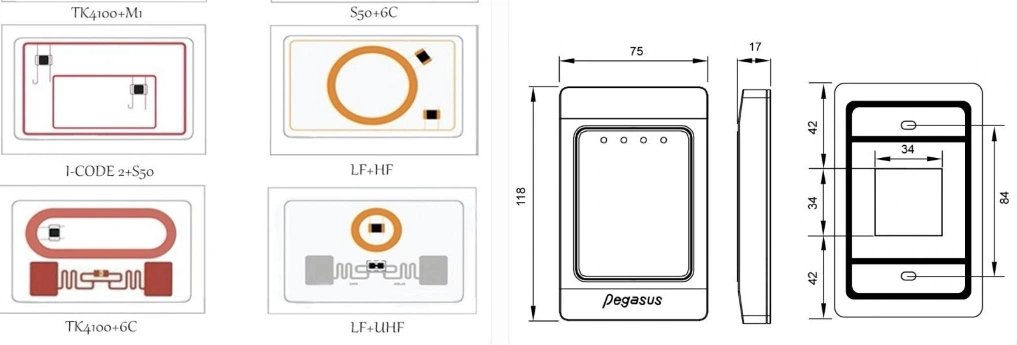
1. LF + HF Combi Hybrid Card
An LF + HF card combines a low-frequency RFID chip with a high-frequency RFID chip.
This configuration is useful for organizations upgrading an access control system without immediately removing all older readers.
For example, a company may have an existing 125 kHz employee access system but want to introduce 13.56 MHz smart cards for new buildings, attendance terminals or other services.
A hybrid card can support both infrastructures during the transition.
Common chip combinations include:
- 125 kHz EM4200 + 13.56 MHz MIFARE Classic
- 125 kHz TK4100 + 13.56 MHz MIFARE Classic
- 125 kHz T5577 + 13.56 MHz MIFARE card
- 125 kHz EM4305 + 13.56 MHz HF card
- 125 kHz LF chip + 13.56 MHz DESFire card
The exact chip selection should be checked against the installed reader models. Some LF systems use proprietary protocols, so matching the frequency alone does not guarantee compatibility.
Recommended applications:
- Office buildings with mixed-generation door access systems
- Universities and educational institutions
- Employee identification and attendance systems
- Hotels and multi-facility access management
- Organizations gradually upgrading their RFID infrastructure
2. HF + UHF Combi Hybrid Card
HF + UHF is one of the most useful configurations when an organization needs both close-range card interaction and longer-range identification.
The HF chip operates at 13.56 MHz and is commonly used for access control, membership, ticketing and contactless transactions.
The UHF chip operates in the regional 860–960 MHz band and can be used for longer-range identification through compatible UHF readers.
For instance, an employee may tap the HF interface at an office door, then use the UHF interface for vehicle identification at a parking entrance.
Typical chip combinations include:
- MIFARE Classic 1K + UHF GEN2
- MIFARE Classic 4K + UHF UCODE
- MIFARE DESFire + UHF GEN2
- HF ICODE + UHF chip
- Other customized HF and UHF combinations
The two chips normally operate through their respective antenna structures. Their placement and antenna design need to be evaluated together to achieve reliable performance.
Recommended applications:
- Parking and vehicle access management
- Warehouses and distribution centers
- Employee identification and attendance
- Membership and loyalty programs
- Logistics and asset identification
- Facilities using both tap-based and long-range RFID systems
For a project requiring long-range UHF reading, the card should be tested with the intended reader, antenna, installation angle and operating environment. A UHF chip’s advertised performance does not automatically represent the reading distance of the finished card in every application.
3. LF + UHF Combi Hybrid Card
An LF + UHF hybrid card combines low-frequency proximity identification with UHF long-range identification.
This combination can support both traditional door access and longer-range tracking or vehicle-related applications.
For example, an industrial facility may use LF credentials for employee access at individual doors while using UHF infrastructure to identify cards or authorized personnel at selected vehicle gates.
Common chip options include:
- EM4200 + UHF GEN2
- TK4100 + UHF UCODE
- T5577 + UHF chip
- Customized LF + UHF combinations
The key benefit is that the organization does not need to force every application onto one frequency.
Recommended applications:
- Industrial facilities
- Vehicle and parking management
- Warehousing and logistics
- Employee access and personnel identification
- Sites maintaining legacy LF access control systems
4. Contact IC + Contactless RFID Hybrid Card
Some projects require a contact smart card interface in addition to an RFID interface.
A contact chip uses conductive contact pads to communicate with a compatible smart card reader. A contactless RFID chip communicates through its antenna.
Examples of possible combinations include:
- SLE5542 + MIFARE
- SLE4442 + MIFARE
- SLE5542 + EM4100 or T5577
- Customized contact IC + HF or other supported RFID technologies
The choice between a logic-encryption chip and a more advanced secure CPU chip should be based on the application’s security requirements.
A contact chip is not automatically a bank-grade security component. For government identity, payment or other regulated applications, the chip platform, security certification, key management and system-level compliance must all be confirmed separately.
Combi Hybrid Card Chip Options
DO RFID supports multiple chip combinations according to customer requirements. The following table gives examples of technologies that can be considered during project configuration.
| RFID Technology | Example Chip Options | Typical Function |
|---|---|---|
| LF 125 kHz | EM4100, TK4100, EM4200, EM4305, T5577 | Proximity identification and compatible LF access systems |
| HF 13.56 MHz | MIFARE S50, MIFARE S70, MIFARE DESFire, ICODE | Contactless access, ticketing and smart card applications |
| UHF | UCODE, GEN2-compatible chips | Long-range identification and tracking |
| Contact IC | SLE5542, SLE4442 | Contact-based smart card functions |
| Magnetic Stripe | HiCo / LoCo | Legacy magnetic-stripe identification |
| Visual Identification | Barcode, QR code, serial number, photo | Human-readable and optical identification |
The table describes chip families and example configurations, not a guarantee that every chip can be combined with every other chip. Final availability, chip revisions, antenna layouts and reader compatibility should be confirmed before production.
Technical Specifications of Custom Combi Hybrid Cards
DO RFID provides customized card structures based on the selected chip combination and the customer’s application.
| Specification | Available Options |
|---|---|
| Product Type | Combi Hybrid Card / Multi-Technology RFID Card |
| Card Size | CR80, approximately 85.5 × 54 mm; custom sizes subject to design |
| Card Thickness | 0.84 mm or customized according to the card structure |
| LF Frequency | 125 kHz / selected 134.2 kHz configurations |
| HF Frequency | 13.56 MHz |
| UHF Frequency | 860–960 MHz, subject to regional requirements |
| Contact Chip | SLE5542, SLE4442 and other options subject to confirmation |
| RFID Chips | MIFARE, EM, TK, UCODE, GEN2-compatible options and others |
| Card Materials | PVC, PET, PETG and other suitable materials |
| Printing | Offset printing, screen printing, thermal printing |
| Surface Finish | Glossy, matte, frosted and UV coating |
| Personalization | Serial number, barcode, QR code, photo and signature panel |
| Additional Options | Magnetic stripe, hot stamping, scratch-off panel, hole punching |
The final thickness and internal layout depend on the number of chips, antenna structures and material layers. For cards containing multiple antennas or contact modules, a sample should be evaluated before confirming mass production.
Where Are Combi Hybrid RFID Cards Used?
A Combi Hybrid Card is most valuable when one organization operates multiple identification systems that cannot easily be replaced at the same time.
Here are several practical examples.
Campus One-Card Programs
A university may use a 13.56 MHz HF card for library services, canteen access, student identification and selected campus services.
However, some buildings may still have 125 kHz access readers.
An LF + HF card can support the two environments while the university gradually upgrades its access infrastructure.
The university should determine whether the two chip identifiers will be linked to the same student record in its management system. This is an important software integration step rather than a function that should be assumed to happen automatically inside the card.
Parking and Building Access
A commercial property may use HF cards for pedestrian entrance gates and UHF readers for vehicle access.
With an HF + UHF card, an employee can use the same credential for both functions.
The HF chip supports close-range interaction, while the UHF chip provides a separate long-range interface.
For parking projects, testing should include card orientation, the position of the card inside a vehicle, the antenna installation location and possible interference from surrounding materials.
Industrial Employee Identification
Manufacturing facilities, warehouses and logistics centers often have different identification requirements.
An employee may need close-range access to production areas, while a logistics department requires longer-range identification at selected gates.
An LF + UHF or HF + UHF card can combine these requirements in one credential.
The card configuration should be matched to the actual tracking process. A hybrid card does not automatically provide continuous real-time personnel tracking; that depends on the reader infrastructure, antenna coverage and software platform.
Government and Enterprise Identification
Government agencies and large enterprises may require multiple interfaces for identification, authentication or legacy system compatibility.
A suitable card may combine a contact IC with a contactless chip or several RFID technologies.
The security architecture must be defined carefully. Customers should specify the required encryption, application structure, key management, chip certification and personalization procedures rather than selecting a card based only on its frequency.
How to Choose the Right Combi Hybrid Card
Selecting the right card starts with the existing system, not the chip catalogue.
We recommend confirming the following information before requesting a quotation.
| Selection Factor | Questions to Confirm |
|---|---|
| Existing Reader | What are the reader brands and model numbers? |
| Frequency | Does the system use 125 kHz, 13.56 MHz or UHF? |
| Chip Protocol | Does it require EM4100, MIFARE, ISO/IEC 14443, ISO/IEC 15693 or EPC Gen2 compatibility? |
| Application | Is the card used for access, attendance, parking, payment or tracking? |
| Chip Architecture | Do you need independent chips or one dual-interface chip? |
| Data Management | Should different chip identifiers be mapped to one user account? |
| Read Range | Is the required interaction close-range or long-range? |
| Security | Is UID identification sufficient, or is encrypted authentication required? |
| Card Structure | Is CR80 standard size suitable? What thickness is required? |
| Personalization | Do you need printing, encoding, numbering, photos or a magnetic stripe? |
| Order Quantity | What are the sample and production quantities? |
A Practical Example: Choosing Between HF + LF and HF + UHF
Suppose a customer operates an office building with an existing 125 kHz access control system and wants to introduce a new 13.56 MHz card platform.
In this case, an LF + HF card may be more appropriate because both technologies are needed for access control across different generations of equipment.
Now consider a logistics company that needs employees to tap a card at office doors but also wants long-range identification at a vehicle gate.
An HF + UHF card may be a more suitable choice.
The correct configuration is therefore determined by the intended use of each chip, rather than simply choosing the card with the greatest number of technologies.
Why Reader Compatibility Matters More Than Frequency Matching
One of the most common mistakes in hybrid card procurement is assuming that two devices are compatible because they operate at the same frequency.
This is not always true.
For example, a 125 kHz reader designed for EM4100-compatible cards may not support every proprietary 125 kHz credential. Similarly, 13.56 MHz readers can support different protocols, chip families and authentication functions.
A compatible system must match more than its operating frequency.
The following details should be checked:
- Frequency compatibility: The reader must support the card’s selected frequency.
- Protocol compatibility: The reader must communicate using the correct air-interface protocol.
- Chip compatibility: The reader and software must support the selected chip family.
- Authentication compatibility: Secure cards may require specific keys, cryptographic settings and application configurations.
- Data format compatibility: The card number, UID, EPC or other identifier must be handled correctly by the system.
- Regional UHF requirements: UHF operating bands must be selected according to the country or region where the system will be installed.
For example, a 13.56 MHz reader does not automatically support every MIFARE, DESFire, ICODE or NFC card. The supported protocol and application functions must be checked.
The same principle applies to UHF cards: confirm the relevant regional band and EPC Gen2 or ISO/IEC 18000-63 support where applicable.
DO RFID also offers RFID Readers for different applications, as well as 125 kHz Low Frequency RFID Modules and 13.56 MHz High Frequency RFID Reader Modules.
How to Prevent Interference in Multi-Frequency Card Design
When several RFID chips and antennas are placed inside one card, the internal layout becomes an important part of product engineering.
Different frequencies require different antenna structures. The position of each antenna, its dimensions and its interaction with nearby components can influence the finished card’s performance.
A multi-frequency card should therefore be designed and tested as a complete assembly.
Important considerations include:
1. Antenna Positioning
The LF, HF and UHF antenna structures should be arranged according to the selected chip specifications. Where necessary, their positions can be adjusted to reduce unwanted interaction.
2. Antenna Matching
Each antenna should be evaluated with its corresponding chip and reader system. Material thickness, card construction and nearby conductive elements can affect performance.
3. Chip Placement
Contact modules, RFID chips and antenna structures must be arranged within the available card area without compromising mechanical strength or the required card thickness.
4. Independent Functional Testing
Each interface should be tested using its corresponding reader. A card that passes an HF test should not automatically be considered qualified for LF or UHF operation.
5. Combined-Use Testing
The finished card should also be checked under realistic conditions, including card orientation, reader distance and repeated reading.
A card may contain correctly specified chips and still perform poorly if the antenna layout or system integration has not been validated.
For this reason, we recommend pre-production samples and application-specific testing before confirming a large order.
Custom Printing and Personalization Options
A Combi Hybrid Card can be customized in appearance as well as electronic configuration.
For businesses, the card is often an employee badge, membership card, identification card or branded customer credential. Its external appearance should therefore match the organization’s visual identity.
Available customization options include:
- Full-color CMYK offset printing
- Screen printing
- Thermal printing
- Individual serial number printing
- Barcode and QR code printing
- Employee photo and name personalization
- Signature panel
- Magnetic stripe
- Gold or silver hot stamping
- Glossy, matte or frosted surface
- UV coating
- Scratch-off panel
- Custom hole punching
Customers can also select PVC, PET or PETG materials depending on card structure and application requirements.
For related products and configurations, explore our RFID Cards, 13.56 MHz High Frequency Cards and NFC Products.
DO RFID Combi Hybrid Card Manufacturing and Customization Process
For B2B customers, an effective manufacturing process should begin with technical confirmation rather than immediately moving to mass production.
At DO RFID, a typical customization project can follow these steps.
Step 1: Confirm the Application
We first identify how the card will be used: building access, attendance, vehicle identification, campus services, logistics or another application.
Step 2: Review Existing RFID Systems
Customers provide the reader model, operating frequency, chip requirements and communication protocol. This helps avoid selecting a chip that cannot work with the existing equipment.
Step 3: Confirm the Chip Combination
We determine whether the project needs LF + HF, HF + UHF, LF + UHF, a contact chip + RFID combination or another supported structure.
Step 4: Confirm Card Structure
We confirm the card dimensions, material, thickness, antenna layout, surface finish and additional personalization requirements.
Step 5: Sample Production and Testing
Samples are prepared for evaluation. Each selected chip should be tested using the corresponding reader, followed by combined-use testing where required.
Step 6: Approve Artwork and Encoding
Customers check the printed design, serial numbers, chip encoding format and any agreed data-personalization requirements.
Step 7: Bulk Production and Quality Inspection
After sample approval, mass production follows the confirmed specifications. Inspection should cover printing appearance, dimensions, card structure, chip functionality and encoding accuracy.
Step 8: Packaging and Delivery
Cards are packed according to order requirements, with packaging and labeling options available for bulk shipments and individual personalization projects.
What Affects the Price of a Combi Hybrid Card?
There is no universal unit price for every Combi Hybrid Card. The price depends on its electronic structure and manufacturing requirements.
The main cost factors include:
| Cost Factor | How It Affects the Price |
|---|---|
| Number of Chips | More chips generally increase component and assembly costs |
| Chip Model | Different chip families have different prices and availability |
| Antenna Design | Custom multi-frequency layouts may require additional engineering |
| Card Material | PVC, PET and PETG options have different material and processing costs |
| Card Thickness | Non-standard structures may require additional production adjustments |
| Printing | Full-color printing, metallic effects and special coatings affect costs |
| Encoding | UID, EPC or customized data encoding adds processing requirements |
| Personalization | Photos, individual names, serial numbers and barcodes affect unit costs |
| Order Quantity | Production volume influences setup costs and unit pricing |
| Testing Requirements | Additional sample evaluation or project-specific testing may affect the quotation |
To obtain an accurate quotation, customers should provide the required chip combination, quantity, card dimensions, artwork, encoding requirements and intended application.
For a complex project, we recommend confirming the technical design and sample performance before comparing prices between suppliers. A lower card price does not necessarily mean a lower total project cost if the cards are incompatible with the installed readers.
Frequently Asked Questions About Combi Hybrid Cards
1. What is the difference between a hybrid card and a normal RFID card?
A normal RFID card generally contains one RFID technology or chip. A hybrid card combines two or more technologies, chips or interfaces in one card body, allowing it to work with different compatible systems.
2. Can one Combi Hybrid Card support 125 kHz and 13.56 MHz?
Yes. An LF + HF configuration can combine a 125 kHz chip with a 13.56 MHz chip. However, the selected chips and their protocols must match the readers used in the project.
3. Can a hybrid card combine HF and UHF?
Yes. HF + UHF is a common combination for projects requiring close-range card interaction and longer-range identification. For example, HF can support office door access, while UHF can support vehicle identification at a parking entrance.
4. Can a Combi Hybrid Card contain three RFID frequencies?
Yes, an LF + HF + UHF configuration can be designed for applications that require three different RFID frequency technologies. The antenna layout, card thickness, chip selection and testing requirements need to be confirmed before production.
5. Do the chips inside a hybrid card share the same memory?
Not necessarily. In a multi-chip hybrid card, each chip normally has its own memory and communication interface. Data can be assigned or mapped to the same user account through the management system, but it is not automatically shared between chips.
A true dual-interface card uses one chip with contact and contactless interfaces, which is a different architecture.
6. Can a Combi Hybrid Card work with existing RFID readers?
It can work with existing readers when the selected chip, frequency, communication protocol, authentication method and data format are compatible.
Before bulk production, customers should provide their reader models or technical specifications for verification.
7. Can I add a magnetic stripe, barcode or QR code?
Yes. Depending on the card structure, magnetic stripes, barcodes, QR codes, serial numbers, signature panels, photos and other personalization options can be added.
8. What is the standard size of a Combi Hybrid Card?
A common format is CR80, approximately 85.5 × 54 mm. DO RFID also offers customized card dimensions and thickness according to project requirements.
9. Does a UHF chip guarantee long-range reading?
No. The actual reading distance depends on the chip, antenna design, reader power, antenna configuration, card orientation, regional frequency regulations and surrounding environment. The finished card should be tested with the intended UHF reader system.
10. What information should I provide when requesting a quotation?
Please provide the required chip combination, frequency, reader model, communication protocol, card quantity, dimensions, material, artwork, encoding requirements and application details. These details help us recommend a suitable configuration and prepare an accurate quotation.
Get a Customized Combi Hybrid Card from DO RFID
A well-designed Combi Hybrid Card helps businesses simplify credential management while maintaining compatibility with different identification and access control technologies.
Whether you need LF + HF for a legacy access control upgrade, HF + UHF for office access and vehicle identification, or a customized combination of contact and contactless chips, selecting the correct chip architecture is essential.
DO RFID provides customized RFID card manufacturing, chip selection, card printing, encoding and project-specific sample support.
Contact our team with your existing reader specifications and application requirements. We can help evaluate the suitable chip combination and card structure for your project.
DO RFID – Custom RFID Card Manufacturer and Supplier
Website: https://www.dorfidreader.com/
Explore more: RFID Cards | Dual Frequency RFID Cards | RFID Readers