
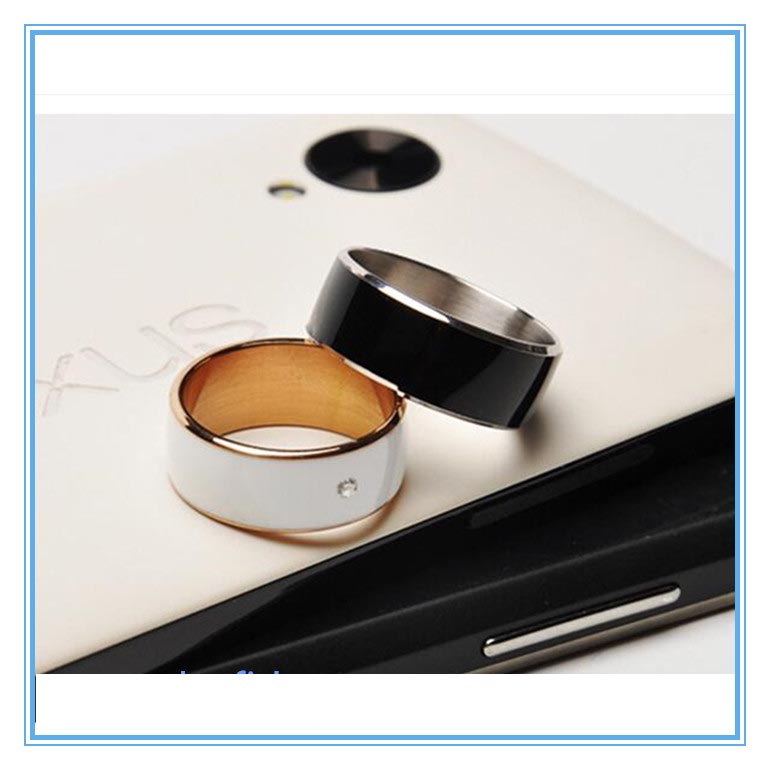
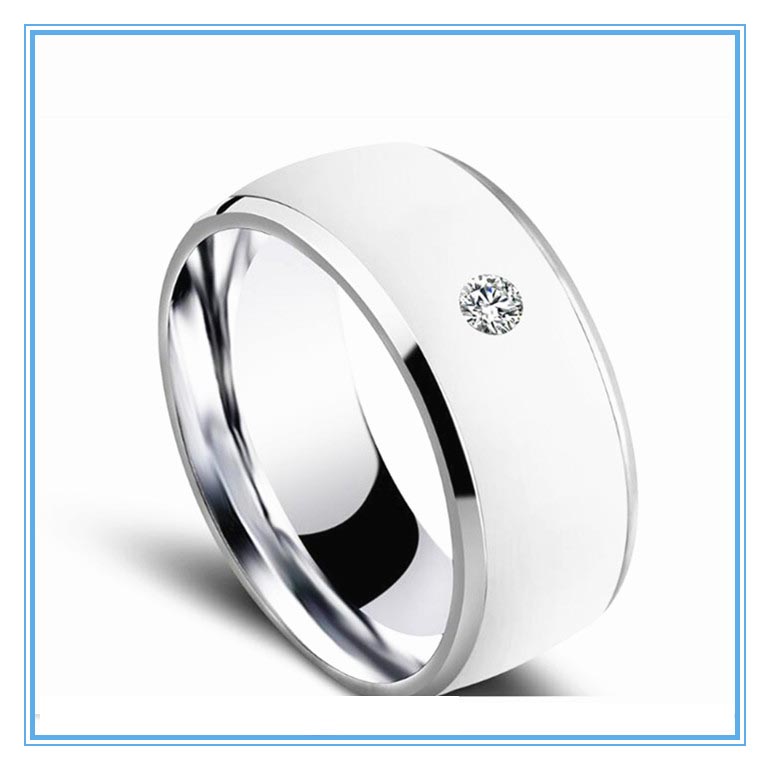
The NFC Smart Ring is a wearable device embedded with a Near Field Communication (NFC) chip that allows secure, contactless data exchange with smartphones, access systems, and payment terminals. Typically made of metal or durable resin, it supports 13.56 MHz HF frequency, with memory options ranging from 96 to 512 bytes for storing IDs, URLs, or digital keys. Operating at -20°C to 50°C, it is waterproof and designed for daily wear. NFC Smart Rings solve problems like secure access control, contactless payments, digital authentication, and personal data sharing, eliminating the need for cards or keys while offering convenience, portability, and enhanced security.



Description
Offering two separate inlays within the ring, the top inlay allows users to share public information with friends, like a Twitter username, using a bump gesture with another device.
The bottom inlay is used to perform more private actions like unlocking your smartphone or placing the palm of your hand on the front door of your home to unlock an NFC-enabled door lock.
Conceptually, the bottom inlay is more secure since the user can clench their fist to protect from any actions or simply keep their hands face down and away from devices. The bottom inlay is also significantly smaller than the top inlay, thus providing additional security for private data and making public data easier to share with an acquaintance.
The read distance is extremely short at just one millimeter and the two inlays to “generate cross talk” in case anyone around you is attempting to read information at a distance using a high-powered antenna.
Primary Applications:
- NFC application
- Access control
- Identification
- Tickets
- E-payment
Specification
| Material | Metal, Steel |
|---|---|
| Size | Various sizes available, or customized size |
| Frequency | 13.56 MHz |
| Protocal | ISO14443A |
| Chip | Ultralight, NTAG 213, NTAG 215, NTAG 216, TOPAZ512, etc |
| Memory | 512 bits, 144 Byte, 504 Byte, 888 Byte, etc |
| Reading or Writing Distance | 1-10cm, depends on the reader and environment |
| Personalization | Encoding, etc |
An NFC smart ring integrates a Near Field Communication chip into a wearable ring, allowing users to exchange information, access compatible systems, and interact with NFC-enabled devices through a simple tap. Unlike conventional smartwatches, most basic NFC rings are passive devices that do not require batteries, charging, or Bluetooth pairing.
For businesses, NFC smart rings offer opportunities in access control, digital business cards, employee identification, membership management, event organization, and connected product experiences. They can also serve as customized promotional products for technology brands and corporate gift distributors.
However, not all NFC rings provide the same functions. A ring with an NTAG213 chip may be suitable for sharing a website link, while a ring intended for an existing access control system may require a specific MIFARE credential. A contactless payment ring needs an entirely different payment-security architecture.
At D.O RFID Group, we provide customized RFID and NFC products for manufacturers, distributors, system integrators, and commercial brands. Our NFC smart ring solutions support different chip configurations, materials, sizes, and data-personalization requirements.
This guide explains how NFC smart rings work, compares available chips and materials, identifies their practical applications, and provides a technical checklist for companies sourcing customized NFC rings in bulk.
What Is an NFC Smart Ring?
An NFC smart ring is a wearable device with an embedded NFC chip and antenna. It uses short-range wireless communication to exchange information with compatible smartphones, NFC readers, and access control systems.
Most standard NFC smart rings use passive HF technology operating at 13.56 MHz. The reader generates an electromagnetic field, which supplies the energy required for the chip to respond.
A typical passive NFC ring includes:
- NFC chip: Stores identification data, URLs, contact information, or supported credentials.
- Antenna: Enables wireless communication with compatible NFC devices.
- Embedded inlay: Holds the electronic components inside the ring structure.
- Ring body: Protects the chip and provides the required appearance and wearing comfort.
- Optional personalization: Supports customized data encoding, logo marking, or other branding requirements.
Unlike an ordinary ring, an NFC smart ring can perform digital functions without requiring a battery.
For example, a user can tap the ring against a compatible smartphone to open a digital business card or present a compatible credential to an access reader.
The NFC Forum identifies 13.56 MHz as the operating frequency of NFC technology and describes its typical communication range as very short, generally up to around 2 cm for NFC Forum-compliant connections. Actual reading distance depends on the device, antenna, and product construction. Source: NFC Forum – NFC Technology.
For business buyers, the key consideration is not simply whether a ring contains an NFC chip. It is whether the chip, antenna, physical structure, and target reader system work together.
Explore our NFC Smart Ring product for available configurations.
How Does an NFC Smart Ring Work?
A standard passive NFC ring communicates through electromagnetic induction.
The process is relatively simple:
Step 1: The NFC device generates a magnetic field.
An NFC-enabled smartphone or reader creates a 13.56 MHz electromagnetic field.
Step 2: The ring receives energy.
The antenna inside the ring captures energy from the reader’s field and activates the NFC chip.
Step 3: The chip responds.
The chip sends its stored information to the reader according to its supported protocol.
Step 4: The receiving device processes the information.
Depending on the chip and programmed data, the receiving phone or reader may open a website, display contact information, retrieve an identification number, or communicate with an access control application.
Step 5: The connected system performs the configured action.
For example, a digital business card ring may open an online contact profile, while an authorized access control credential may allow entry through a compatible door reader.
<text color=”secondary” size=”sm”>Typical communication sequence: NFC-enabled device → electromagnetic field → ring antenna → NFC chip → data response → compatible application or system.</text>
Because the standard passive NFC ring does not require a battery, there is no regular charging requirement. Its functionality depends on the compatible NFC reader and the data stored or configured on the chip.
Android’s official developer documentation explains how NFC-enabled Android devices discover tags and process NDEF messages, including URLs and other supported data records. Source: Android Developers – NFC Basics.
What Can an NFC Smart Ring Do?
An NFC smart ring can support several applications, but its actual capabilities depend on the chip, reader, software platform, and access permissions.
1. Digital Business Card and Contact Sharing
One of the simplest NFC ring applications is digital contact sharing.
A ring can store a URL in an NDEF record. When another person taps it with a compatible smartphone, the phone can open a digital profile containing:
- Name and company
- Job title
- Telephone number
- Email address
- Website
- Social media profiles
- Business contact information
This is particularly useful for sales professionals, business owners, exhibition participants, consultants, and marketing teams.
An important advantage is that the ring does not necessarily need to store the complete contact profile. It can store a URL pointing to an online profile. If the company changes its telephone number or website information, the profile can be updated without rewriting the ring, provided the link remains valid.
For corporate buyers, this approach also makes it easier to manage a large group of employee rings through a centralized profile system.
2. Door Access Control
NFC rings can replace selected access cards or key fobs when the embedded chip is compatible with the installed access control system.
Potential applications include:
- Office doors
- Residential buildings
- Hotel facilities
- Fitness centers
- Private clubs
- Employee-only areas
- Smart home door locks
However, not every NFC chip is compatible with every access reader.
A door lock designed for MIFARE credentials may not accept a basic NTAG213 tag. Similarly, an access system operating at 125 kHz cannot automatically read a 13.56 MHz NFC ring.
For B2B projects, the existing reader model and credential requirements should be confirmed before selecting the ring chip.
3. Employee Identification and Membership Management
Companies can use NFC rings as wearable identification credentials.
A ring can be linked to an employee or membership record, allowing authorized systems to identify the user through a compatible reader.
Typical applications include:
- Employee identification
- Gym membership
- Club membership
- Visitor management
- Attendance systems
- Restricted-area access
For larger organizations, unique identifiers can be encoded and registered in the management platform before distribution.
4. Smartphone Interaction and Smart Home Automation
An NFC smart ring can also act as a trigger for compatible smartphone or smart home workflows.
Examples include:
- Opening a website or mobile application
- Sharing Wi-Fi information
- Opening a digital contact profile
- Launching a configured phone workflow
- Triggering selected home automation actions
These functions depend on the phone’s NFC capabilities, operating system, application configuration, and the data format stored on the chip.
5. Event Ticketing and Access Management
For exhibitions, concerts, private events, and recreational facilities, NFC rings can serve as wearable credentials.
A compatible reader can identify the ring and check the associated ticket or visitor record.
Potential benefits include reduced dependence on printed tickets, convenient credential presentation, and easier integration with digital visitor management systems.
6. Contactless Payments: An Important Technical Distinction
Many NFC smart ring product pages advertise payment applications. However, a normal NTAG213, NTAG215, or NTAG216 ring does not automatically function as a bank-card payment device.
There are different product architectures:
| Ring Type | Payment Capability | Main Requirement |
|---|---|---|
| Standard NTAG NFC ring | Not automatically compatible with open-loop bank card payments | Stores standard NFC data such as URLs or identifiers |
| Access control NFC ring | May work with compatible closed-loop payment or membership systems | Reader and backend compatibility |
| Dedicated payment ring | Designed for supported contactless payment systems | Secure payment credential, tokenization, payment platform, and issuer/network support |
Dedicated payment products, such as RingPay, describe connecting a payment card through a compatible app and payment service. Their function is different from simply storing an NDEF URL on an NTAG chip.
For companies planning to launch a payment-enabled ring, payment technology, security certification, tokenization, and financial partner integration must be confirmed separately.
NFC Smart Ring vs. Traditional Smart Ring: What Is the Difference?
The term smart ring is used for several different wearable products. Buyers should distinguish a passive NFC ring from a battery-powered health-monitoring ring.
| Comparison | Passive NFC Smart Ring | Electronic Health Smart Ring |
|---|---|---|
| Main technology | NFC chip and antenna | Sensors, processor, battery, and wireless communication |
| Power source | Reader-generated energy | Rechargeable battery |
| Charging | Not required | Required |
| Main functions | Identification, access, contact sharing | Health and activity monitoring |
| Sensors | Usually none | May include motion, temperature, or other sensors |
| Phone connection | NFC tap | Typically Bluetooth or an associated application |
| Hardware complexity | Relatively simple | More complex |
| Maintenance | Minimal for the chip itself | Battery and software maintenance |
A passive NFC ring should not be advertised as automatically tracking heart rate, blood oxygen, sleep, or daily activity unless it actually contains the required sensors and electronic components.
For wholesale buyers, this distinction matters because the materials, production process, unit cost, certification, and after-sales requirements of these two products are very different.
Which NFC Chip Should You Choose for a Smart Ring?
Chip selection is one of the most important parts of an OEM NFC ring project.
The chip determines supported communication standards, memory capacity, and available security functions.
DO RFID’s published NFC smart ring page lists several chip options, including Ultralight, NTAG213, NTAG215, NTAG216, and TOPAZ512. Final compatibility depends on the specific chip and target reader. Source: DO RFID – NFC Smart Ring Specifications.
NTAG213 vs. NTAG215 vs. NTAG216
The NXP NTAG21x family is commonly used in NFC stickers, smart labels, retail products, and smartphone-interactive applications.
| Specification | NTAG213 | NTAG215 | NTAG216 |
|---|---|---|---|
| Frequency | 13.56 MHz | 13.56 MHz | 13.56 MHz |
| Standard | NFC Forum Type 2 | NFC Forum Type 2 | NFC Forum Type 2 |
| Protocol | ISO/IEC 14443 Type A | ISO/IEC 14443 Type A | ISO/IEC 14443 Type A |
| User Memory | 144 bytes | 504 bytes | 888 bytes |
| Total EEPROM | 180 bytes | 540 bytes | 924 bytes |
| Data Transfer Rate | 106 kbit/s | 106 kbit/s | 106 kbit/s |
| Typical Application | URLs, simple contact sharing | More complex NDEF records | Larger data requirements |
These specifications are published by NXP and should be checked against the exact chip variant and current datasheet. Total EEPROM capacity is not the same as freely available user memory.
Which NTAG Chip Is Best for NFC Rings?
NTAG213 – For Basic Digital Sharing
NTAG213 is suitable for rings used to share:
- Website URLs
- Digital business cards
- Social media profiles
- Basic product information
- Short identification records
For many digital business card applications, a simple URL requires relatively little memory. Therefore, a larger chip is not always necessary.
NTAG215 – For Medium Data Requirements
NTAG215 offers more user memory than NTAG213. It can be considered when the application requires additional NDEF records or more stored information.
NTAG216 – For Higher Memory Requirements
NTAG216 offers 888 bytes of user memory. It may be more appropriate for projects with larger data structures or multiple records.
However, higher memory capacity does not automatically provide stronger security. If authentication or secure access is required, buyers should evaluate the security architecture rather than selecting a chip based only on memory.
What About MIFARE and Other RFID Chips?
Some NFC rings are designed for specific access control systems rather than general smartphone interactions.
For example:
- NTAG213/215/216 are commonly used for smartphone-readable NFC applications.
- MIFARE products may be suitable for compatible HF access control systems.
- TOPAZ or other NFC chip families require verification of reader and phone compatibility.
- 125 kHz proximity chips are LF RFID technologies, not 13.56 MHz NFC chips.
The key rule is to select the chip according to the existing reader system. A ring’s external appearance does not determine its electronic compatibility.
What Materials Are Used to Manufacture NFC Smart Rings?
The ring body affects appearance, comfort, mechanical performance, and electronic integration.
The chip and antenna are embedded within the ring structure, so the material and internal construction must be considered together.
1. Zirconia Ceramic
Zirconia ceramic is widely used in NFC ring designs because it offers a smooth surface, a premium appearance, and good resistance to everyday surface wear.
Potential advantages include:
- Glossy or matte finishes
- Black, white, and customized color options
- Smooth wearing surface
- Suitable housing for embedded NFC components
- Premium jewelry-style appearance
Typical applications: Fashion accessories, digital business card rings, corporate gifts, and selected access credentials.
One consideration is its brittleness. Ceramic may resist surface scratches well but can chip or crack after a strong impact against a hard surface.
2. Stainless Steel and Metal
Metal rings provide a robust and familiar jewelry appearance.
Possible advantages include:
- Metallic finish
- Strong structural feel
- Multiple surface treatments
- Suitable for selected premium designs
However, metal can interfere with NFC antenna performance if the antenna is not properly isolated or designed for the finished structure.
Therefore, a metal NFC ring needs a carefully engineered antenna and inlay arrangement. Always test the completed ring rather than evaluating an exposed chip or inlay alone.
3. Titanium
Titanium can be considered for lightweight and premium wearable designs.
The final product still needs to address antenna integration, surface finish, wearing comfort, and chip protection.
4. Resin and Epoxy
Resin can be used for selected decorative ring structures and embedded components.
Depending on the design, it allows different colors, visual effects, and encapsulation options.
Material Comparison
| Material | Appearance | Main Advantages | Main Considerations |
|---|---|---|---|
| Zirconia Ceramic | Glossy or matte | Premium finish and good surface hardness | Can chip under hard impact |
| Stainless Steel | Metallic | Strong and durable structure | Requires careful NFC antenna engineering |
| Titanium | Metallic | Lightweight premium construction | Higher material and processing requirements |
| Resin / Epoxy | Customized colors and effects | Flexible design possibilities | Performance depends on resin and encapsulation quality |
For B2B buyers, the material should be selected based on the target market, expected use, and overall product design rather than appearance alone.
DO RFID NFC Smart Ring: Product Specifications and Customization
DO RFID’s published NFC Smart Ring product is described as a wearable ring with a 13.56 MHz NFC chip.
The page lists metal and steel construction, customized sizes, ISO 14443A communication, and several chip options. The final configuration should be confirmed for each order.
| Specification | Published Product Information |
|---|---|
| Product Name | NFC Smart Ring |
| Product Type | Passive NFC wearable |
| Frequency | 13.56 MHz |
| Protocol | ISO/IEC 14443 Type A |
| Chip Options | Ultralight, NTAG213, NTAG215, NTAG216, TOPAZ512, and other compatible options subject to confirmation |
| Memory Options | Depends on the selected chip |
| Material | Metal / steel construction listed; other material options require confirmation |
| Ring Size | Various sizes or customized size |
| Data Personalization | Encoding and customized data |
| Main Applications | Access control, identification, tickets, information sharing, and compatible systems |
Source: DO RFID – NFC Smart Ring Product Page.
Customization Options for OEM and Wholesale Buyers
DO RFID supports product customization according to the selected construction and project requirements.
Potential customization areas include:
- Ring size
- Ring width and thickness
- Material and surface finish
- Color
- Chip model
- NFC data encoding
- UID or identification data management where supported
- Logo engraving or laser marking
- Customized gift packaging
- Bulk order configuration
The final customization options depend on the ring structure and production feasibility.
For example, a digital business card ring may only need a standard NTAG chip and a programmed URL, while an access control ring may require a specific chip type and compatibility test with the customer’s reader.
How to Choose the Correct NFC Smart Ring Size
Ring sizing is an important issue for OEM buyers because a ring that does not fit comfortably is unlikely to be used consistently.
Before confirming a production order, specify:
- International ring size standard
- Inside diameter
- Inside circumference
- Ring width
- Ring thickness
- Target finger
- Required size distribution
Practical Sizing Recommendations
- Measure the finger that will actually wear the ring.
- Measure when the finger is at a normal or slightly larger daily size.
- Confirm that the ring can pass over the knuckle comfortably.
- Compare measurements against the supplier’s actual size chart.
- Approve a physical sample before finalizing the size distribution.
Do not rely on a generic size conversion chart alone. Different ring manufacturers may use different production tolerances, and some ring constructions cannot be resized after assembly.
For bulk orders, a size-sampling kit or representative size samples can help reduce incorrect sizing and returns.
NFC Smart Ring vs. NFC Card vs. NFC Key Fob
For access control and identification projects, buyers should compare the ring with other contactless credentials.
| Comparison | NFC Smart Ring | NFC Card | NFC Key Fob |
|---|---|---|---|
| Wearing / Carrying | Worn on the finger | Stored in a wallet or card holder | Attached to keys or a bag |
| Convenience | Always worn when in use | Requires carrying the card | Requires carrying the fob |
| Branding | Customized ring surface | Large printing area | Compact logo area |
| Material | Ceramic, metal, resin, or other designs | PVC, PET, composite materials | ABS, epoxy, or other housing |
| Size | Limited by finger dimensions | Standard card format or custom size | Compact |
| Main Applications | Access, identification, sharing | Access, membership, identification | Door access and equipment identification |
| Customization | Size, material, color, engraving, chip | Printing, chip, card dimensions | Shell, logo, chip, color |
A ring is useful when users prefer a wearable credential. Cards may be more suitable for organizations issuing credentials to large employee groups, while key fobs can be a practical alternative for users who do not wear rings.
For related NFC products and alternative formats, visit our NFC product range.
How to Program an NFC Smart Ring
Most standard passive NFC rings can be programmed using compatible NFC-enabled smartphones or NFC reader/writer devices.
The chip and software determine which data can be written and whether the tag can be rewritten.
Common NFC Data Types
| Data Type | Example Application |
|---|---|
| URL | Website or digital business card |
| Text | Short message or identification |
| vCard | Contact details |
| Wi-Fi information | Network connection information |
| Application link | Opens a supported mobile application |
| Identification data | Connects the ring to an access or membership record |
Basic Programming Process
Step 1: Confirm the NFC chip.
Identify whether the ring uses NTAG213, NTAG215, NTAG216, or another chip.
Step 2: Select the compatible programming device.
Use an NFC-enabled smartphone or compatible reader/writer.
Step 3: Prepare the data.
Create the URL, vCard, text, or other supported NDEF record.
Step 4: Write the information.
Place the ring near the NFC antenna and write the selected record.
Step 5: Read it back.
Verify that the data has been stored correctly.
Step 6: Test on another device.
Check that the programmed ring works with the intended receiving smartphone or reader.
For detailed instructions, see our guides:
- How to Program NFC Tags: A Complete Practical Guide
- How to Use NTAG215 NFC Tags: Read, Write, and Program Them
For larger OEM orders, pre-encoding can be arranged according to the approved data structure and production requirements.
NFC Smart Ring Security: What Should Businesses Know?
Security is particularly important when an NFC ring is used as an access credential or digital identification device.
Not all NFC chips provide the same protection.
A basic NFC tag may store a URL or identifier, while a secure chip can support additional authentication and access-control functions.
Basic NFC Data vs. Secure NFC Authentication
| Feature | Basic NFC Tag | Secure NFC Credential |
|---|---|---|
| Stores URLs or IDs | Yes | Yes, depending on configuration |
| Data reading | Depends on access configuration | Controlled by the chip’s security functions |
| Password protection | Available on selected chips | Depends on chip architecture |
| Cryptographic authentication | Not generally provided by basic NTAG21x tags | Available on suitable secure-chip products |
| Suitable for banking payment | No, not by itself | Requires payment-system integration and certification |
| Suitable for controlled access | Only when the reader and system accept the credential | Depends on the access system and credential architecture |
NCC Group’s research on NFC chip security explains that password protection and write protection should be configured correctly, and that basic memory-protection features do not automatically protect a chip against more sophisticated attacks.
For business projects, we recommend:
- Do not store sensitive personal information directly on a basic NFC ring.
- Use a controlled backend system for employee or member information.
- Choose a suitable secure chip where cryptographic authentication is required.
- Disable or restrict unnecessary write access.
- Establish a procedure to revoke a lost or stolen access credential.
- Test the ring with the existing reader and security system before deployment.
If the ring is used for door access, the security level depends on the complete system—not just the physical ring.
NFC Smart Ring Manufacturer Comparison: What Should B2B Buyers Look For?
Different suppliers focus on different NFC ring designs and applications. Some specialize in ceramic rings and standard programmable chips, while others emphasize digital business cards or dedicated payment systems.
The following comparison summarizes their publicly described product approaches. It is not an independently audited ranking.
| Supplier / Brand | Published Product Focus | Notable Features | Main Purchasing Consideration |
|---|---|---|---|
| DO RFID | Customized NFC smart rings | 13.56 MHz, multiple chip options, customized size and encoding | Confirm final material, ring dimensions, and reader compatibility |
| Proud Tek | Ceramic NFC rings | Zirconia ceramic, NTAG, MIFARE and 125 kHz chip options, US sizes #6–15 | Useful chip-selection and access-system distinctions |
| RFIDTag | NTAG216 NFC rings | Ceramic, wood, metal/ceramic and epoxy styles; US sizes #6–12 | Material and design variety |
| Ping | NFC business card rings | NTAG216, digital profile sharing, user experience and profile platform | Check phone experience and subscription model |
| RingPay | Contactless payment rings | Payment platform, supported bank cards, payment credential and tokenization | Designed for payment use, not generic NFC programming |
DO RFID: Customizable NFC Ring Supply
DO RFID’s published product focuses on passive NFC rings for information sharing, identification, and compatible access systems.
Its product page lists multiple chip options and customized sizing. For B2B buyers, the main evaluation points are the final chip configuration, material structure, and compatibility with the intended reader.
Official Product: DO RFID NFC Smart Ring.
Proud Tek: Ceramic Ring and Multi-Frequency Options
Proud Tek describes zirconia ceramic rings with chip options including NTAG213/215/216 for smartphone interactions, MIFARE Classic for compatible HF access systems, and ATA5577 for selected 125 kHz readers.
Its published sizing range includes US sizes #6–#15. The company also highlights the importance of checking chip-reader compatibility and measuring the ring before ordering.
RFIDTag: Multiple Materials and Ring Styles
RFIDTag publishes an NTAG216 NFC ring product with material options including wood, tungsten steel with zirconia ceramic, and ceramic/epoxy combinations.
Its product information lists US sizes #6–#12 and 888 bytes of user memory for the NTAG216 chip.
Ping: Digital Business Card Ring Experience
Ping focuses on the digital networking use case. Its published buyer guide discusses ring sizing, phone compatibility, recipient experience, materials, and subscription considerations.
This highlights an important point for OEM brands: the experience after tapping can be just as important as the NFC chip itself. A programmed URL should take the recipient directly to a clear, mobile-friendly destination.
RingPay: Dedicated Payment Architecture
RingPay offers contactless payment rings using a connected payment platform and supported card relationships. This is a different commercial and technical model from a standard NFC ring containing a programmable NTAG chip.
How Should You Compare NFC Ring Suppliers?
For wholesale and OEM orders, compare:
- Exact chip manufacturer and model.
- Ring material and physical construction.
- Available ring sizes and size tolerances.
- NFC reading performance in the finished ring.
- Phone and access-reader compatibility.
- Encoding and data-management services.
- Waterproof or environmental test evidence.
- Logo customization and packaging.
- Sample availability and lead time.
- Quality inspection and repeat-order consistency.
A supplier that can provide a sample, chip datasheet, size chart, and compatibility test is easier to evaluate than one that only provides attractive product photos.
What Determines the Price of an NFC Smart Ring?
NFC smart ring prices vary according to the chip, material, finishing, size, customization, and order quantity.
The main cost factors include:
1. NFC Chip: Different chip models provide different memory and security functions.
2. Ring Material: Ceramic, stainless steel, titanium, and resin constructions have different raw-material and processing costs.
3. Ring Size: Multiple size requirements may create additional production and inventory complexity.
4. Antenna and Inlay Design: The internal NFC construction affects performance and assembly requirements.
5. Surface Finishing: Polishing, coating, engraving, and customized colors can affect the final price.
6. Data Encoding: Individual URLs, identifiers, or customized information require additional preparation and testing.
7. Packaging: Individual gift boxes, branded packaging, and customized inserts can increase the total cost.
8. Order Quantity: Material purchasing and production setup influence the unit price.
Information Required for a Wholesale Quotation
| RFQ Item | Information to Provide |
|---|---|
| Product Type | Standard NFC ring, access control ring, or digital business card ring |
| Chip | NTAG213, NTAG215, NTAG216, MIFARE, or specified chip |
| Frequency | 13.56 MHz for standard NFC configurations |
| Protocol | Confirm the chip’s supported protocol |
| Material | Ceramic, metal, titanium, resin, or other |
| Ring Size | US size or exact inside diameter/circumference |
| Color | Standard or customized color |
| Surface Finish | Glossy, matte, brushed, polished, or coated |
| Logo | Laser engraving, printing, or other available branding |
| Encoding | Blank, URL, vCard, ID, or customized data |
| Packaging | Bulk packaging or customized retail packaging |
| Quantity | Sample order and bulk order volume |
| Application | Smartphone interaction, access, membership, or other use |
For accurate pricing, buyers should provide the intended application and reader information rather than asking for a generic NFC ring quotation.
How to Customize NFC Smart Rings with DO RFID
At D.O RFID Group, we support customized RFID and NFC products for distributors, brands, system integrators, and business customers.
Our NFC smart ring customization process is designed to match the electronic configuration and physical construction to the customer’s application.
Step 1: Confirm the Application
Tell us whether the ring will be used for digital business cards, door access, employee identification, membership management, event ticketing, or promotional products.
Step 2: Select the NFC Chip
Choose a chip according to the required smartphone or reader compatibility, memory, and security functions.
For access control projects, provide the existing reader model or credential specification.
Step 3: Choose the Ring Material
Evaluate ceramic, metal, or other available constructions according to the target market, appearance, and application conditions.
Step 4: Confirm the Ring Size
Provide the required ring size distribution or exact measurements.
A physical sizing sample is recommended for projects involving several sizes.
Step 5: Confirm Personalization
Provide the logo, color, surface finish, and encoding requirements.
For unique identifiers, establish the numbering or data format before production.
Step 6: Test the Sample
Test the finished ring with the intended NFC smartphone or access reader.
Check reading consistency, ring comfort, physical finish, and data accuracy.
Step 7: Approve Mass Production
Confirm the final construction, chip, size, customization, packaging, quantity, and inspection requirements.
Step 8: Quality Inspection and Delivery
Inspect the finished rings according to the approved specification before export packing and shipment.
For repeat orders, keep the approved sample and production specification to maintain consistency.
Common Problems When Buying NFC Smart Rings and How to Solve Them
Problem 1: The Ring Does Not Work with the Existing Door Lock
Possible cause: The ring uses a different chip or frequency from the access control reader.
Solution: Identify the existing credential technology and reader model. Confirm whether the system accepts NTAG, MIFARE, or another credential type. Test a sample before ordering in bulk.
Problem 2: A Smartphone Cannot Read the Ring
Possible causes: Incorrect tag position, phone compatibility, NFC settings, antenna orientation, or an unsuitable ring construction.
Solution: Test with multiple compatible phones and locate the NFC antenna area on each device. Confirm the chip and antenna configuration in the finished ring.
Problem 3: The Ring Is Too Tight or Loose
Possible cause: The buyer selected a size based on an inaccurate measurement or an unsuitable conversion chart.
Solution: Use a physical ring sizer or confirm the inside diameter and circumference. Approve representative sizes before mass production.
Problem 4: The Ring Cannot Perform Bank Card Payments
Possible cause: The product contains a standard NFC tag rather than a payment credential.
Solution: Clearly distinguish between programmable NFC rings and dedicated payment rings. Payment products require suitable secure credentials and payment platform integration.
Problem 5: The NFC Ring Has Unreliable Reading Performance
Possible causes: Antenna detuning, ring material, inlay placement, reader alignment, or internal construction.
Solution: Evaluate the complete ring structure, not just the bare chip. Test several ring orientations with the actual smartphone or reader.
Problem 6: The Ring’s Data Becomes Outdated
Possible cause: Contact information or URLs are stored directly on the tag and are no longer valid.
Solution: For digital business card applications, consider programming a stable URL that points to an editable online profile.
Problem 7: The Ring Is Lost
Possible concern: An access credential may remain valid after the physical ring is lost.
Solution: Link credentials to a management system that supports revocation or deactivation. Establish a procedure to disable lost rings promptly.
Frequently Asked Questions About NFC Smart Rings
Do NFC Smart Rings Need Charging?
Most basic passive NFC rings do not require batteries or charging. They receive the energy needed for communication from a compatible NFC reader or smartphone.
Can an NFC Smart Ring Unlock Any Door?
No. The ring must contain a chip or credential format accepted by the door’s access control reader. Check the reader’s frequency, protocol, and credential requirements before ordering.
Can NFC Smart Rings Make Contactless Payments?
Only dedicated payment-ring products with suitable payment credentials and platform support can perform supported bank-card transactions. A standard NTAG213, NTAG215, or NTAG216 ring is not automatically a bank payment device.
Does an NFC Smart Ring Work with iPhone and Android?
Standard NFC tags can be read by compatible smartphones, but behavior depends on the phone model, operating system, NFC settings, chip type, and data format. Test the target devices before approving a commercial deployment.
What Is the Reading Distance of an NFC Smart Ring?
NFC is designed for very short-range interaction. NFC Forum describes a typical range up to around 2 cm for compliant connections. Actual performance varies according to antenna size, reader design, alignment, and ring construction.
Which Is Better, NTAG213 or NTAG216?
NTAG213 provides 144 bytes of user memory and is generally suitable for simple URLs and short data records. NTAG216 provides 888 bytes and is more suitable when additional data capacity is required. The best choice depends on the application, not memory capacity alone.
Are NFC Smart Rings Waterproof?
Water resistance depends on the complete ring construction and its sealing process. Buyers should request the IP rating and test evidence for the exact model. Do not assume all ceramic, metal, or resin rings have the same waterproof performance.
Can NFC Smart Rings Be Customized with a Company Logo?
Yes. Depending on the selected ring material and manufacturing process, customization may include laser engraving, surface marking, logo printing, colors, and customized packaging.
Can I Program an NFC Smart Ring Myself?
Many standard NTAG-based rings can be programmed using a compatible smartphone or NFC reader/writer. Some access credentials or secured systems require specific authorization or encoding procedures.
Can One NFC Ring Have Two Different Chips?
Dual-chip designs may be possible, but the internal antenna layout must be evaluated carefully. Two closely positioned coils can interfere with one another or reduce reading performance. A prototype should be tested on both intended readers before bulk production.
What Information Is Needed to Order NFC Smart Rings in Bulk?
Provide the chip type, frequency, ring material, size distribution, color, logo, encoding requirements, intended application, quantity, and target reader model if applicable.
Request a Custom NFC Smart Ring Quotation from DO RFID
An NFC smart ring combines wearable design with contactless electronic identification. For business customers, the key to a successful project is selecting a suitable chip, antenna construction, ring material, size, and data configuration.
A standard NTAG ring may be ideal for digital business cards and simple smartphone interactions. A compatible MIFARE ring may suit a selected access control system, while a dedicated payment ring requires additional payment-security infrastructure.
At D.O RFID Group, we provide customized NFC and RFID products for brand owners, distributors, system integrators, and commercial customers.
Whether you require standard NTAG-based smart rings, customized access control rings, or branded wearable NFC products, our team can help review your technical requirements and discuss a suitable manufacturing configuration.
Visit our NFC Smart Ring product page or explore our NFC product range to learn more.
Contact D.O RFID Group
- Website: https://www.dorfidreader.com/
- Product: NFC Smart Ring
- NFC Products: NFC Tags, Cards and Related Products
- Email: Contact our team through the official website inquiry form.